
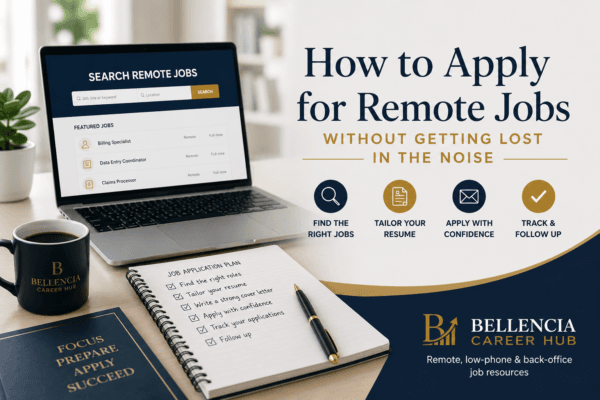
How to Apply for Remote Jobs Without Getting Lost in the Noise
May 6, 2026
Trending Finds Readers Are Loving
Explore affordable luxe discoveries people are clicking on right now.
See What's TrendingApplying for remote jobs can feel overwhelming because so many listings sound the same. One job says “operations support,” another says “data coordinator,” and another says “customer success,” but the actual work may be completely different. That is why a smarter application strategy matters.
Instead of applying to every remote job you see, focus on roles that match your strengths, your schedule, and your comfort level. If you want less phone work, your search should be intentional from the beginning.
Start With the Right Search Terms

Many job seekers only search “remote jobs,” but that keyword is too broad. It brings up everything from sales calls to customer service queues to commission-only opportunities.
Better search terms include:
Remote data entry
Remote billing specialist
Remote claims support
Remote order processing
Remote operations coordinator
Remote document review
Remote invoice specialist
Remote payment posting
Remote fraud analyst
Remote quality assurance analyst
Remote back-office support
Low-phone remote jobs
Non-phone remote jobs
These terms help you find roles where the work is more focused on processing, reviewing, documenting, tracking, or coordinating instead of taking calls all day.
Read the Job Description Carefully

A job title does not always tell the full story. A “specialist” role could be very phone-heavy, or it could be mostly data entry and email follow-up.
Look for phrases like:
“High call volume”
“Inbound and outbound calls”
“Call center environment”
“Answer customer inquiries by phone”
“Must be comfortable taking calls”
Those usually mean the role may involve a lot of phone time.
On the other hand, these phrases may point to lower-phone or back-office work:
“Data validation”
“Order processing”
“Claims review”
“Payment posting”
“Invoice reconciliation”
“Documentation”
“Work queue”
“Ticket tracking”
“Case management”
“Email communication”
“Quality checks”
The goal is not to avoid every job that mentions phone communication. The goal is to understand how much phone work is actually involved before you apply.
Match Your Resume to the Role

One resume will not work for every job. If you are applying for a billing role, your resume should highlight accuracy, reconciliation, payment tracking, Excel, and account review. If you are applying for an operations role, highlight workflow tracking, task management, documentation, and cross-team communication.
For remote jobs, employers want to see that you can work independently. Strong resume phrases include:
Maintained accurate records in high-volume work queues
Reviewed account details for accuracy and completeness
Resolved discrepancies using internal tools and documentation
Managed time-sensitive tasks while meeting production goals
Communicated professionally with internal teams and external contacts
Used Excel and business systems to track, validate, and report data
Your resume should make it easy for the employer to see the connection between your past work and the job they are hiring for now.
Apply Early, But Do Not Rush
Remote jobs can receive hundreds of applications quickly. Applying early helps, but rushing can hurt you if your resume is not aligned with the job.
Before submitting, check three things:
Does your resume use keywords from the job description?
Does your experience clearly match the duties?
Did you remove anything that makes you look unrelated to the role?
A focused application is stronger than a rushed one.
Keep a Job Tracker

A simple tracker can help you stay organized and avoid applying to the same role twice. Track:
Company name
Job title
Date applied
Pay range
Remote or hybrid
Phone level
Application status
Follow-up date
Notes about the role
This also helps you notice patterns. If you keep getting interviews for billing roles but not data roles, that tells you where your resume is performing best.
Final Takeaway
The best remote job strategy is not applying everywhere. It is applying with direction.
Use better search terms, read the job description closely, tailor your resume, and track your applications. The more intentional you are, the easier it becomes to find remote, low-phone, and back-office roles that actually fit your life.